Sunday, 1 May 2016

Figure exploration

Figure exploration


For this stage in my project, I wanted to start looking at the human profile to gain some experience for my final pieces. I will be creating three portraits of different Indigenous cultures and will need some experience in looking at human characteristics. 

Collage


Collage


Looking at Ben Stainton, a collage artist and Robert Beatty, a psychedelic concept artist gave me a few ideas on how to experiment with collage. As of late, my main focus has been on studying the visual elements most prominent in the Indigenous cultures. After my trip to the museum and looking at the line, pattern and colour in a lot of their clothes, jewelry and art work, I've been looking at artists and techniques with similar aspects. The collages I've created have been influenced by Stainton in collage, colour and Beatty in colour and mixed media, strying to create that psychedelic and weird aesthetic.

One thing I noticed when creating the collage experiments was the focal point being on the eyes. With the eyes being the focal point and the vibrant fluid paint composition, it reflects inner emotion and abstract energy. I've chosen to create an experiment using a Native American Indian to create that contrast and show the history behind that particular Indigenous group.

The mayflower steps


Mayflower steps


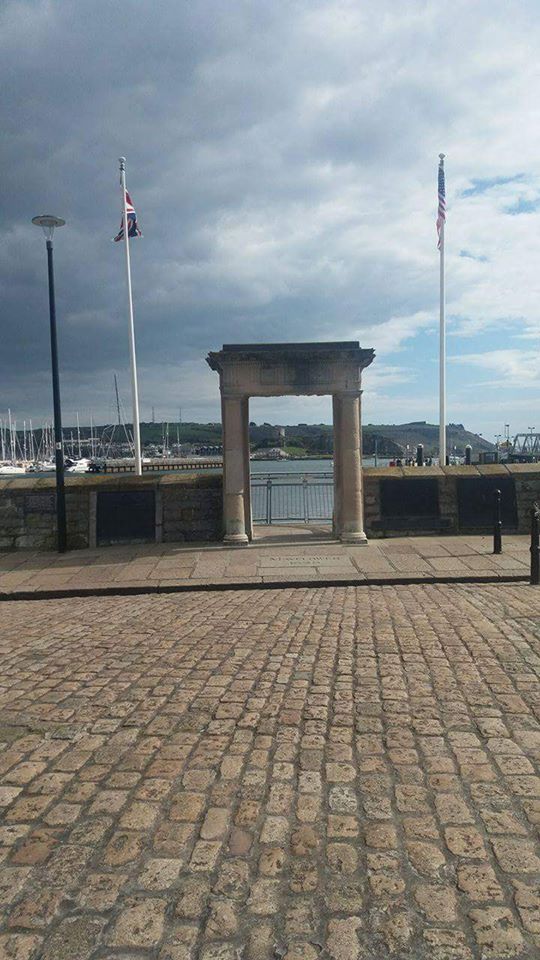
To gain some perspective of the political, historical and social aspects of my concept, I decided to visit the mayflower steps, an opportunity that many other people wouldn't get to take advantage of if they were doing a similar project to me, seeing as I actually live in the historical location of where the pilgrims set off to travel to America nearly four hundred years ago.

Political - The decision made by Great British Empire at the time to travel to a foreign land to colonize, causing the mass destruction of a whole Indigenous society of native american Indians and also nearly driving the American Bison, the native american's main source of meat and fur, to extinction.

Historical - The event is a massive part of not only American but British history, as it lead on to other events such as the celebration of American independence on the fourth of July from the British Empire. It marks the start of America as a country, and the start of the decline                                                    in Native American Indian population.

                                                 Social - The even brought on many social matters, many being the                                                           way we regard different cultures in our society. The event brought on                                                     the celebration of thanks giving, which celebrates the Indians and the                                                     pilgrims coming together to form a friendship almost. This changed                                                     the way we looked at other cultures, especially in a time when we were                                                 so blind to them and only invaded countries to conquer. I think that to                                                  this day, we still can relate to that moment in time and we are still                                                          exploring other cultures so different to our own, like I am doing for my                                                   project.   

                                                Cultural - The mayflower steps reflects a symbolic moment in time                                                       when two cultures cam together to help one another and forgive after so                                                  much death and destruction. I feel like it has still impacted both our                                                         culture and the Indigenous culture of the Native American Indians.  

To me, The mayflower steps show the re-connection between two cultures and our own morality after causing so much death just to conquer a foreign land in the name of a country the Americans derived from. I will be using the Native American Indian cultural within my final pieces and will explore what to use and why.

Sunday, 20 March 2016

Creating paint


To explore the Indigenous culture when approaching the art, I wanted to create my own paints after doing much research into the resources often used within the Indigenous culture. A lot of contemporary artist materials are derived from many Indigenous resources such as acrylic, charcoal and others.


When exploring the idea of using natural paints, I decided to take a trip to the beach and see what natural materials I could find to make into paints. When I was there, I found a lot of shells and soft rocks to make into paint and used the pulling end of the hammer to mine into the soft rock, finding the cores of certain rocks to be bright orange like copper or clay.


When I'd collected all of my resources, I headed home where I ground up the different rocks to see what different colour paints they could make and tried mixing them with different things to the base colour.


I found that when I mixed the ground up rock with too much water, it became almost transparent and didn't hold together very well on the page.


However, I also tried mixing the ground rock with egg and found that although it mixed together well in the mortar and pestle, when I applied it to the page, it was not a whole colour and was too transparent, something I've found a lot even when PVA glue is used to make paint.


Over all, I feel that the most successful rocks were the two bottom rocks which created solid colours that stuck to the page when I applied them instead of turning transparent. I also feel that they were the most vivid colours, and relate to my ongoing theme of the vibrant culture of Indigenous people.


This rock created a dull and almost transparent colour of paint and when I applied it to the page, I feel that it was unsuccessful in forming a solid colour which brings me to the conclusion that I will not be using it again.


This rock created a murky beige colour that formed a solid colour efficiently and was soft enough to grind into a paint. I feel that this rock was successful in giving me a solid colour and would consider using it again in the future.


This rock produced a dark auburn or amber colour after grinding it and adding a slight amount of water to it. I feel that this was the most successful rock to grind into paint as it was softer than the others and I found it easy to grind. The rock produced a colour that was both vibrant and earthy which relates to my concept of reconnecting with nature and feel that I would definitely use the rock again.


Saturday, 19 March 2016

Jason Liosatos gallery


To get a further understanding of Indigenous art work, I visited the Jason Liosatos gallery in Totnes.


When observing the many Indigenous portraits of African culture, I found a better understanding of how I could take my work further into developing a solid final piece idea. When I found different perspectives of portraits, it gave me more ideas in terms of how I could experiment to further my creative process such as life drawing experiments or colour experiments in deeper tone and not just looking at line, colour and pattern but the different tones also.


The visual elements that I observed during my time at the gallery were certainly the different tones and mixtures of realistic and surreal colour. The visual elements helped build the portraits into realistic and vivid images based on primary images of memories.


I feel like this visit has definitely helped me develop my ideas further in terms of what experiments I would like to do next. I will look at figure drawing as an experiment that I can voice these ideas with and look at exploring the different tone and colour whilst I do so.

Pitching my ideas

To help with our own development and to give our peers a good idea of what our thoughts are for our final major project piece, we individually pitched our ideas in a small group and had to share our artistic journey so far. We were each judged on our use of body language, confidence, eye contact, enthusiasm, structure, volume, speed, language and content. I feel that personally, my pitch was successful in terms of body language and eye contact but that it could have used more structure and speed to show my ideas more clearly. I feel that not speeding up my pitch disabled me from being able to talk more about the future experiments, research and artist studies I wanted to explore to help me develop my project further.

Thursday, 17 March 2016

Fluid painting

After exploring the visual elements that I feel are most prominent in the Indigenous culture, I decided to look into art work that strongly represented the line, pattern and colour in the aesthetic. After remembering looking at a nail painting technique called water marble and remembering the music video for Tame Impala in which they poured and layered different coloured paints onto a silhouette to make the human form into a vibrant, abstract shape, I decided to research further into these two techniques and tried to find any that were similar in the artistic field. After research, I found a technique of abstract, psychedelic painting called fluid painting.

Fluid painting is a form of painting where you continually pour paint onto a wet surface of choice and use different colours to pour into the spot of paint previously poured onto the page. In doing so, this creates a series of colourful rings in each section of the page and can be manipulated by moving the surface around to drip the paint into different patterns or even use a thin object such as a pencil or a toothpick to drag the colours into desired shapes, patterns and forms.

I found this particularly interesting and managed to find a series of successful and contemporary fluid painting artists such as Nancy Wood, whose own painting I have found reflect quite an organic concept, deriving from possibly using natural forms to inspire her ideas. I also found the printing artist Leif Podhajsky whose concept derives from looking at ideas of connectedness, something I could relate to immediately with my own work.